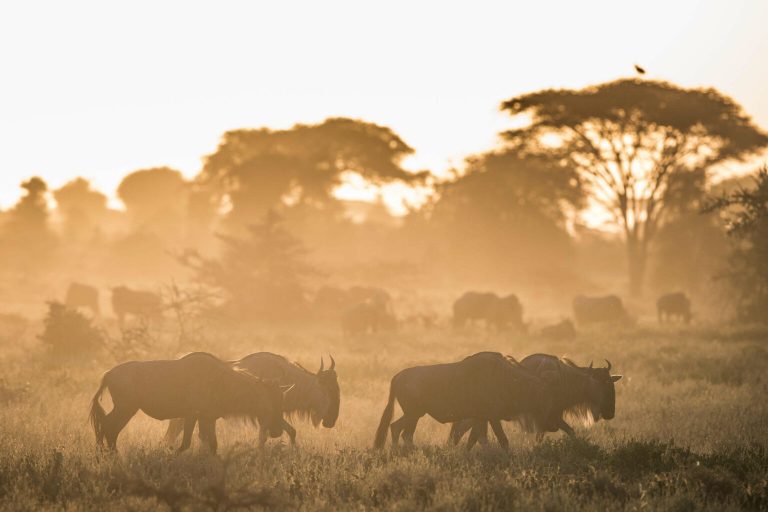
Serengeti National Park is the definitive endless plains, a premier big cat and Big Five country, and home of the Great Migration. The vast park hosts the highest concentration of predators in the world, making it one of Africa’s premier safari destinations.
During any Tanzania safari, you can experience some of Serengeti’s unmatched wildlife viewing: watch a pride of lions stalk across the open plains, witness millions of wildebeest and zebras follow their age-old migration route, or gaze at the powder-blue skies stretching over the grasslands as far as the eye can see.
Serengeti National Park at a Glance
Serengeti National Park is located in northern Tanzania spanning approximately 14,750 square kilometers (5,700 square miles). It borders the Masai Mara in southwestern Kenya, forming the Serengeti-Mara ecosystem, which provides the backdrop for one of the planet’s most impressive natural spectacles: the wildebeest Migration.
The name “Serengeti” means “endless plains” in the Maasai language, Maa. It comes from the word “siringet,” which translates to “the place where the land runs on forever” or “endless plains,” rightly describing the expansive, open savanna of the park. Serengeti is the second largest park in Tanzania after Nyerere National Park.
The park is bordered by the Ngorongoro Conservation Area to the southeast, Maswa Game Reserve to the southwest, the Ikorongo and Grumeti Game Reserves to the west, and the Loliondo Game Control Area to the northeast and east. These areas form the larger Serengeti-Ngorongoro ecosystem which is instrumental in the wildebeest migration.
The Ndutu plains, located in the northwestern edge of the Ngorongoro Conservation Area, serve as a crucial calving ground for wildebeest during the calving season from December to March.
The park is a UNESCO World Heritage Site and divided into three distinct geographic regions;
- The southern plains which are characterized by vast expanses of undulating savannahs and serve as a breeding ground for the wildebeest from December to May before the herds migrate northwards.
- The Western Corridor which constitutes the Grumeti River and the adjacent tangled riverine forests.
- The remote northern region, which consists of woodlands, making it a convenient place for spotting elephants and giraffes and witnessing the dramatic river crossings. It spans from Seronera in the south to the Mara River on the Kenyan border.
Scattered throughout the Serengeti are massive, ancient granite rock outcrops (inselbergs) known as kopjes, which rise from the grasslands, acting as “islands” for wildlife. These formations are often used by big cats like lions and leopards as resting places and lookout points to scout out their prey. The most famous are the Moru Kopjes in the central Serengeti.
While Serengeti boasts a wealth of resident wildlife, it is perhaps most famous for the iconic wildebeest migration, where millions of wildebeest and zebra thunder across the grassy plains into Masai Mara every year in search of fresh grazing.
Undoubtedly, Serengeti National Park is nature at its wildest, ensuring a picture-perfect safari that fulfills your wildest dreams time and time again. Yet, there is far more to explore and experience beyond the Great Migration. Why not explore some of the more remote corners of this iconic national park, meet the distinct Maasai people, or take to the skies on a hot air balloon safari?
Wildlife in Serengeti National Park
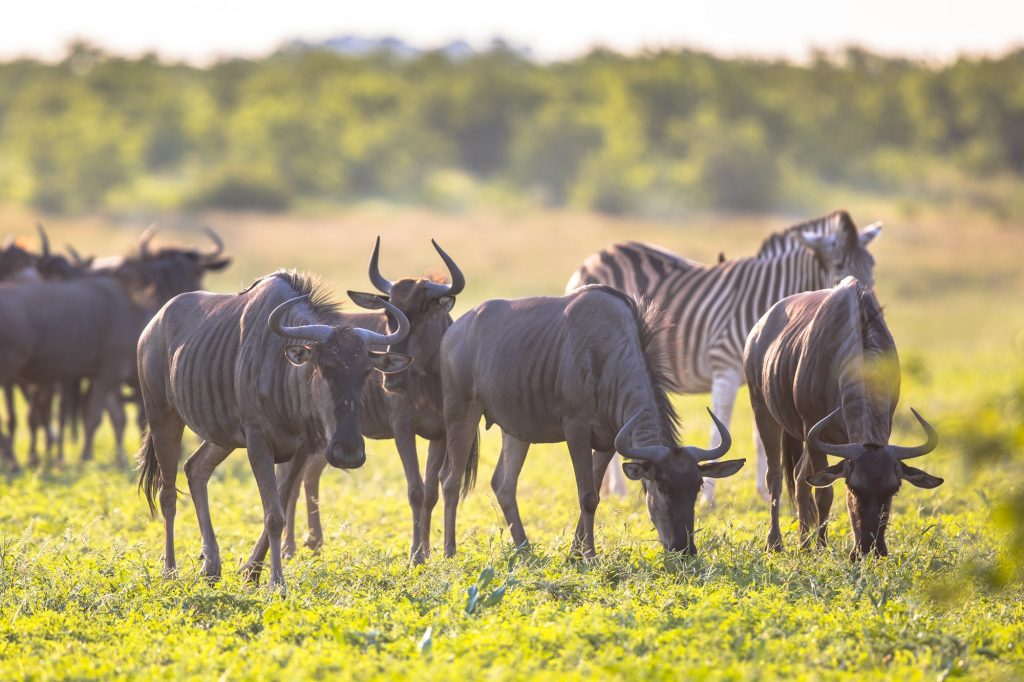
The Serengeti is home to some of Africa’s iconic wildlife including the Big Five (elephant, rhino, buffalo, lion and leopard), wildebeest, zebras, giraffes, Thomson’s gazelle, topi, eland, hartebeest, hyenas, cheetahs, hippos, crocodiles, caracal, serval, bat-eared fox, and primates such as baboons, vervet and colobus monkeys.
Several rare species, including the pangolin, East African oryx, white rhino, and wild dog, are present. Black rhinos can be found in the Moru Kopjes area.
Serengeti boasts no fewer than 500 resident and migratory avian species, five of which are endemic to Tanzania. Avid birders will probably look out for Grey-breasted spurfowl, Rufous-tailed weaver, and the gorgeously colorful Fischer’s lovebird. The Usambiro barbet and the Hildebrandt’s starling are near-endemic specials.
Serengeti National Park Entry Fees
Non-residents (foreign tourists) pay USD 70 per adult per 24 hours during peak season and USD 60 per adult per 24 hours during low season. Children aged 5 to 15 years pay USD 20 per 24 hours during peak or low season. Children under the age of 5 years are not charged. Please note these rates are 18% VAT inclusive.
Expatriates or residents pay US$ 35 per adult per 24 hours during peak or low season. Children aged 5 to 15 years pay USD 10 per 24 hours during peak or low season.
Tanzanians or East African citizens pay Tsh 10,000 per adult per 24 hours during peak or low season, while children aged 5 to 15 years pay Tsh 2000 per 24 hours during peak or low season.
Best time to visit Serengeti National Park
The best time to visit Serengeti is in the dry season, from June to October or from January to February, especially if you plan your trip around the Great Migration. However, the Serengeti is always full of surprises, no matter the time of year you visit.
The density of wildlife alone offers an unparalleled safari experience throughout the year. You just need to know where to go and when to travel.
Getting to Serengeti National Park
Most international flights to Tanzania arrive at Julius Nyerere International Airport (DAR) in Dar es Salaam, and travelers then connect to Arusha Airport (ARK) or Kilimanjaro International Airport (JRO) for safaris in the Serengeti.
There are regular flights from Arusha to one of several airstrips located within the park: Kusini and Ndutu in the south; Lobo, Kleins, and Kogatende in the north; Seronera in the center; and either Grumeti or Sasakwa in the Western Corridor.
You can also embark on a 325 km/200 mi scenic road trip in about 8 hours and most likely enter through the Naabi Hill Gate in the southeastern section of the park.
Where to Stay in Serengeti National Park
Accommodations in Serengeti National Park range from romantic tented camps to exclusive safari lodges and private villas. Mobile camps follow the migration, ensuring you’re always at the heart of the action, while those on a tight budget can use the park’s public campsites. Here are some of our hand-picked accommodations.
- Four Seasons Safari Lodge Serengeti
- Singita Faru Faru Lodge
- Mbalageti Safari Camp
- Kirawira Serena Camp
- &Beyond Serengeti Under Canvas
- Elewana Serengeti Pioneer Camp
- Wilderness Usawa Serengeti Camp
- Namiri Plains
- Alex Walker’s Serian Serengeti North
- Alex Walker’s Serian Serengeti South
Tips for visiting Serengeti National Park
- If you’re planning a trip around the wildebeest migration, June to October is ideal for the dramatic river crossings in the north, and late December to March is good timing for the calving season in the south.
- The Serengeti Great Migration usually coincides with the peak season (June to October). As such, we recommend booking your safari at least 12-18 months in advance.
- Pack appropriate clothing for your trip, such as long-sleeved shirts and long pants, sturdy closed boots for hiking, a warm jacket, waterproof jacket, a daypack and mosquito repellent, among others.
- Carry the right equipment for photography or video. A strong digital zoom or a lens with a focal length of at least 200 mm will do much.
Trips to inspire